

Is there a future for Missing Middle Housing in Sacramento?
Planning and Design Commission considers how to get our landmark housing law to actually build housing

On Thursday, the Planning and Design Commission will host a workshop on the “2040 General Plan & Zoning Consistency.”
I know — somehow we’re still doing this. But this is going to be a really important meeting. This starts the process to turn the Missing Middle Interim Ordinance (the temporary law that legalized small multifamily citywide) into permanent zoning code.
If you don’t care about any of the wonky details and just want to help, stop reading, click here and add an eComment something to the effect of this (and then show up at Planning Commission Thursday, 5:30PM at City Hall to say the same):
Please just get rid of bulk control and do not replace it with bulk control 2.0. I support legalizing simple three-story buildings in my neighborhood and every neighborhood.
But if you — like me — find this stuff fascinating, read on. The staff report is a very interesting document. There’s a ton between the lines.
Why are we still tinkering with this?
First of all, if you find the staff report complicated, it’s not just you. Opticos, the city’s design consultants, are proposing a finely tuned set of options based on four different “context” maps, three Missing Middle “typologies,” three proposed floor area ratios,1 and three different possible “degrees of change.”2
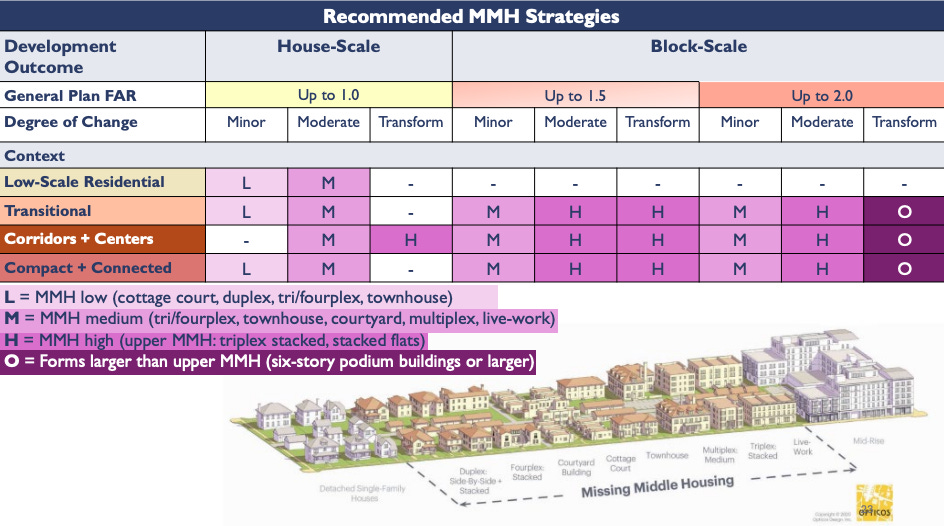
It’s been a year and a half since Sacramento became the first city in the country to move entirely to a form-based code and legalize multifamily everywhere in the city — all in the name of simplification. So why are we suddenly making everything so complicated?
The answer is buried on page 34 of the staff report.
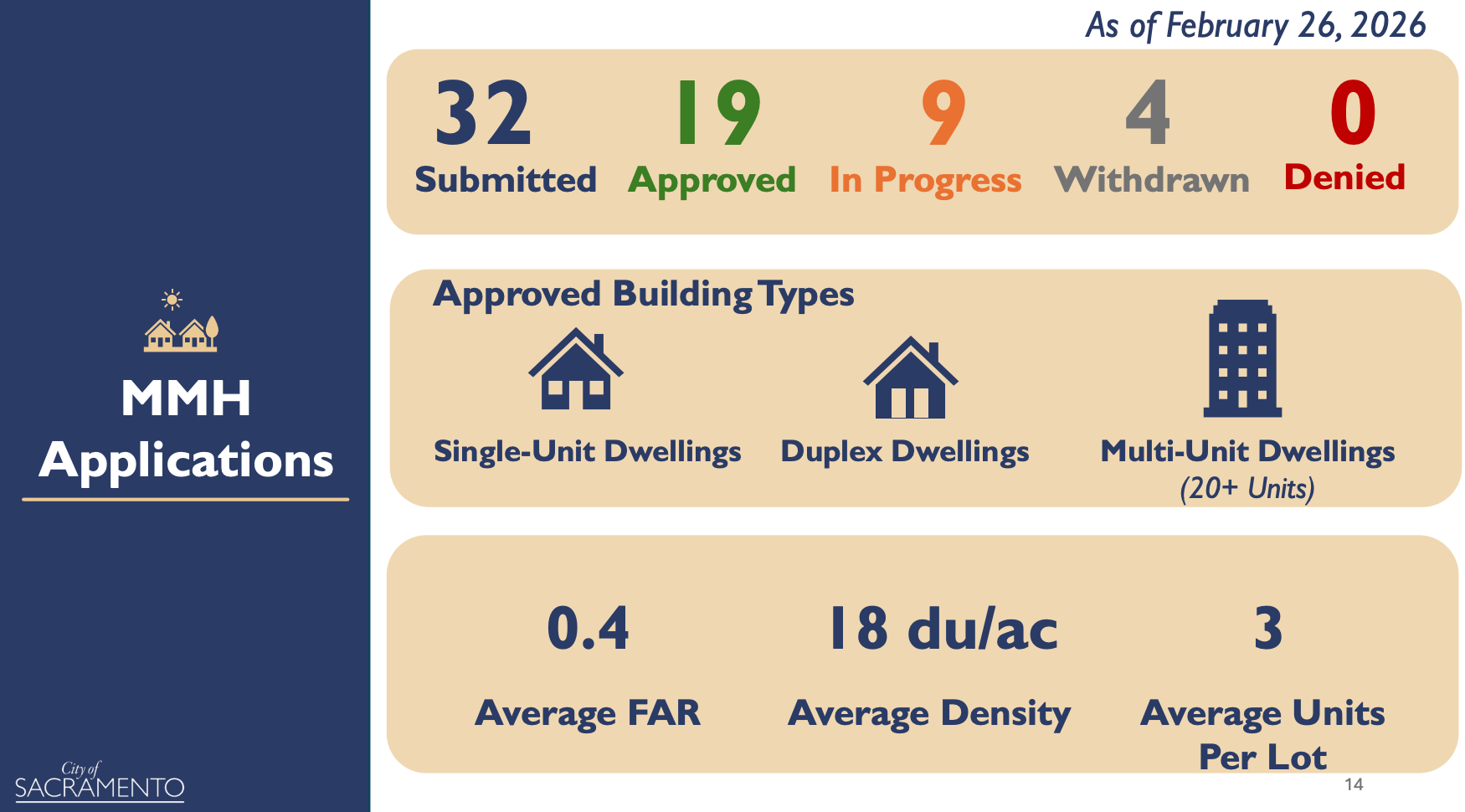
Translation: We’re not seeing the production that City Hall was hoping for.
Just 19 projects have been approved, with an average of 3 units each. That’s ~57 homes. Not nothing! But 57 homes is definitely not going to end homelessness in Sacramento. (We also apparently haven’t seen any of the small multiplexes that we were hoping for?)
No word on how many homes have actually been built yet. I suspect it’s close to zero.
Plus, my impression (as a weirdo who lurks on Sacramento’s AgencyCounter permit tracker portal) is that these 19 projects have been concentrated on the Grid and in Oak Park, places that already have lots of small multifamily. The interim ordinance has not exactly opened up the rest of the city to the benefits of more housing types…
So my first reaction is: instead of going backwards and complicating things further, we should keep simplifying and just remove complications in the existing law.
Why has Missing Middle not delivered yet?
Thankfully, there’s an obvious simplification; it’s likely the biggest obstacle to projects at scale.3 It’s a dog that only barks once in this document — blink and you’ll miss it:

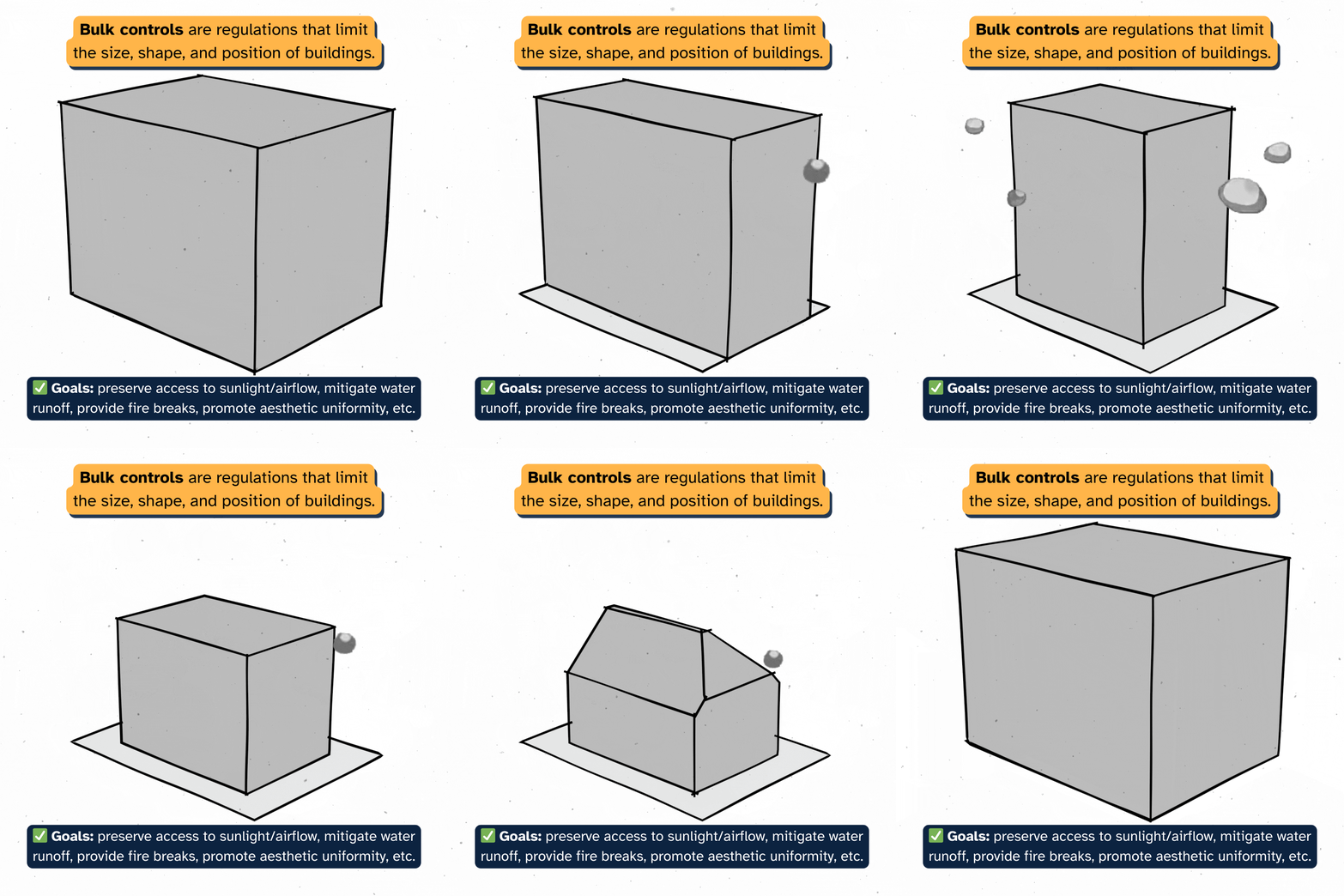
That’s right, the city is proposing removing bulk control everywhere. (!!) For those who remember the Great Bulk Control Saga of 2024,4 this is a convoluted mathematical calculation that creates a unique, triangular 3D envelope on every lot that all projects have to fit within. It’s a ban on rectangular building aesthetics.
Strong SacTown’s Troy Sankey wrote an inspired explainer here, including this (friggin’ incredible) animation:
First impression — great news! House Sacramento has heard from prospective developers that bulk control was the obstacle to building in practice. It adds 10-20% to the cost and makes it impossible to build simple stacked three- and six-plexes and three-story townhomes, the workhorses of Missing Middle.
Au revoir, bulk control. Don’t let the door hit you on the way out.
Second impression — maybbbeee this is not as good as it seems. It kind of looks like we’re considering adding bulk control 2.0 back in the fine print.
City staff is proposing replacing bulk control with something called “House Scale Development Standards,” which would limit Missing Middle projects to 2.5 stories, with a third story only allowed in an “attic story” with dormers.
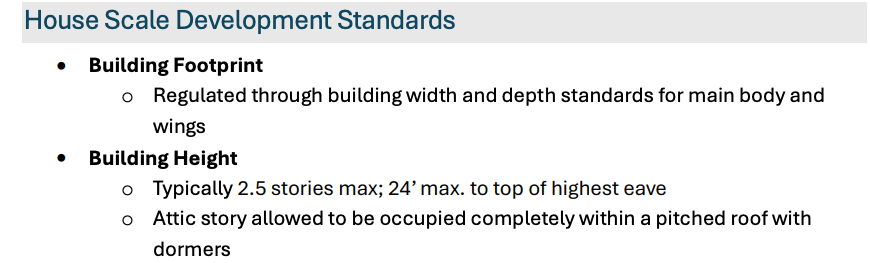
I’m not sure if this is better or worse. On one hand, this is at least simpler (you don’t need a 3D model), but on the other, it still looks a heck of a lot like bulk control 1.0 and could actually be harmful on large lots — like those in Northgate or South Sac — where bulk control is less of an obstacle.
In practice, this bulk control 2.0 likely just means Missing Middle housing will still be de facto limited to two stories, not three.5
To what lengths are we willing to go to protect certain neighborhoods from apartments that look like apartments?
This is just the staff report and we’ll hear what the city actually presents on Thursday, but my guess is this complex proposal has a simple explanation. It’s driven by deep angst over the idea of a rectangular, three-story building in Pocket or River Park.
Sacramento wants to build Missing Middle everywhere. But I suspect some staff (or maybe city consultants) are still very afraid of backlash to Missing Middle Housing if it doesn’t look like a 1950s single-family home.
Personally, I think this fear is overblown. Sacramento’s electorate is militantly pro-housing and even the most (scare quotes) “controversial” projects — like the six-story, 332-unit apartment building across from single-family homes in East Sac that Planning Commission unanimously approved in February — bring out far more supporters than detractors.
Also, remember: The Missing Middle ordinance has only permitted ~57 units so far! At that rate, this program would take 350 years to meet our 2030 RHNA targets. No changes we make are going to release a torrent of development or “transform” the city anytime soon. Change is slower than advocates like me wish it was and city planners fear it could be.
More importantly, by clinging to bulk-control-by-another-name, we would deprive much of the city of the benefits of actual neighborhood scale multifamily, which, spoiler alert… generally does not look like dormered single-family homes.
For example, my favorite project in the city is 1221 C St (Zillow listing here). It’s the dream for what the city should want to see built. 22 homes across two adjacent single-family lots in Mansion Flats. Tons of shared outdoor space. Lots of bike parking.
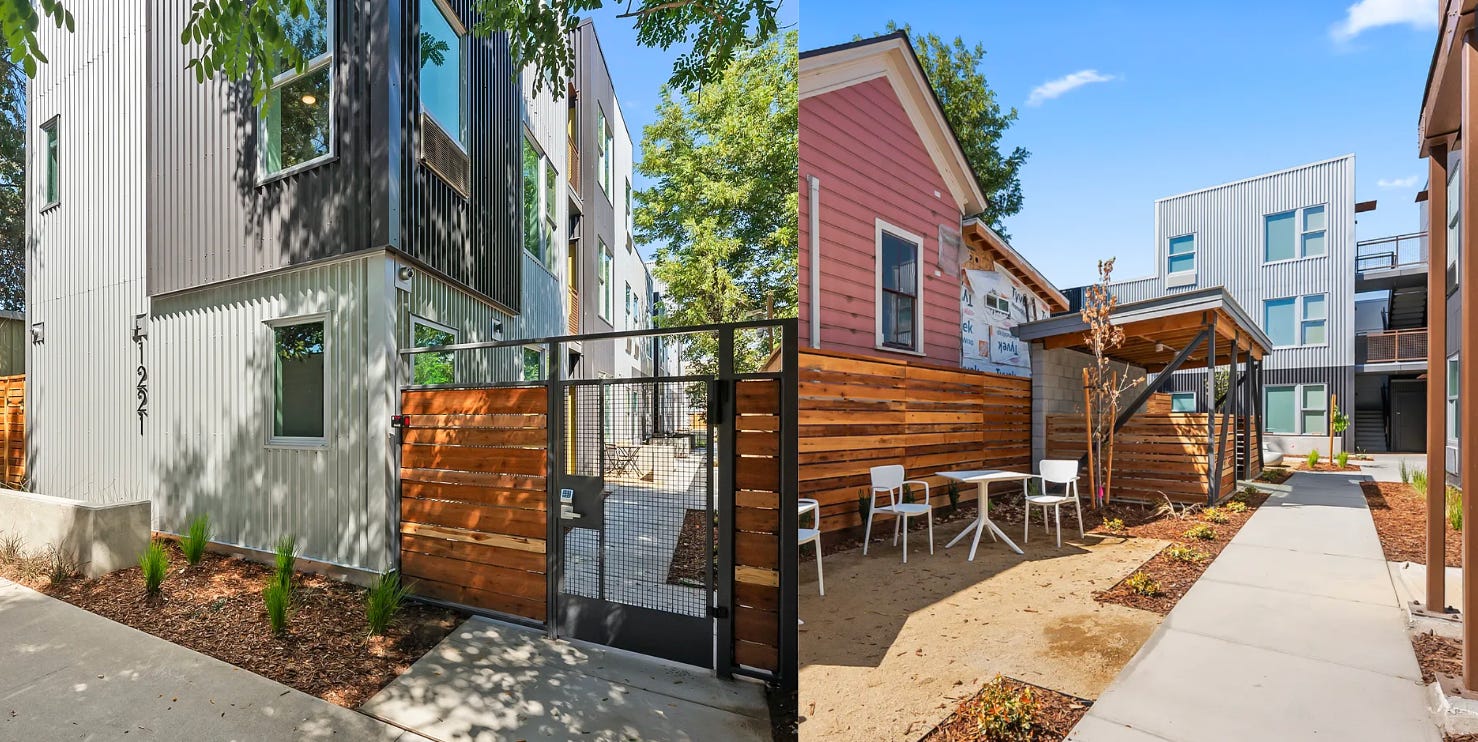
These are brand new, market-rate 1bd/1ba apartments currently priced at just $1,408/mo, roughly affordable at 65% of AMI. They even accept SHRA housing choice vouchers, making them accessible to people who used to be homeless.
These market-rate homes are remarkably affordable because their physical structure is very simple. They are stacks of identical floor plans on top of each other, not a bespoke set of different units fit into an approximation of a gabled single-family home.
These are legal to build — sans bulk control — because Mansion Flats is a historically poorer neighborhood and was never zoned single-family. But they would look great in Land Park or East Sac or Natomas or Pocket or Tahoe Park.
(1221 C St is close to City Hall, so you can stop to check them out on your way there Thursday.)
Planning Commission faces tradeoffs between history and the future
All that said, there’s also a lot of good in this document that I’m excited about. (I do believe city staff is, despite potentially overcomplicating things, really trying hard to make this ordinance build housing.)
First, moving to width/depth standards instead of setbacks, open space, and lot coverage could be a good idea. Again, simpler is better. Width/depth is simpler than setbacks, open space, and lot coverage. Ergo: 👍. Although to be honest, I haven’t heard anyone complaining about the setbacks or lot coverage?
Second, there’s a proposal in here for creating a different category of “Block Scale” Missing Middle for 4- or 5-story buildings, depending on whether lots are adjacent to single-family homes. Presumably no bulk control 1.0 or 2.0.
This is a great idea — four stories might be what it takes to get Missing Middle to pencil in higher-land-value neighborhoods. But everything depends on where the city is considering applying these new and more generous standards.
The proposal doesn’t get into that, but there are three maps for imagined Missing Middle zones — what they’re calling “Compact + Connected,” “Transitional,” and “Low-Scale Residential.”
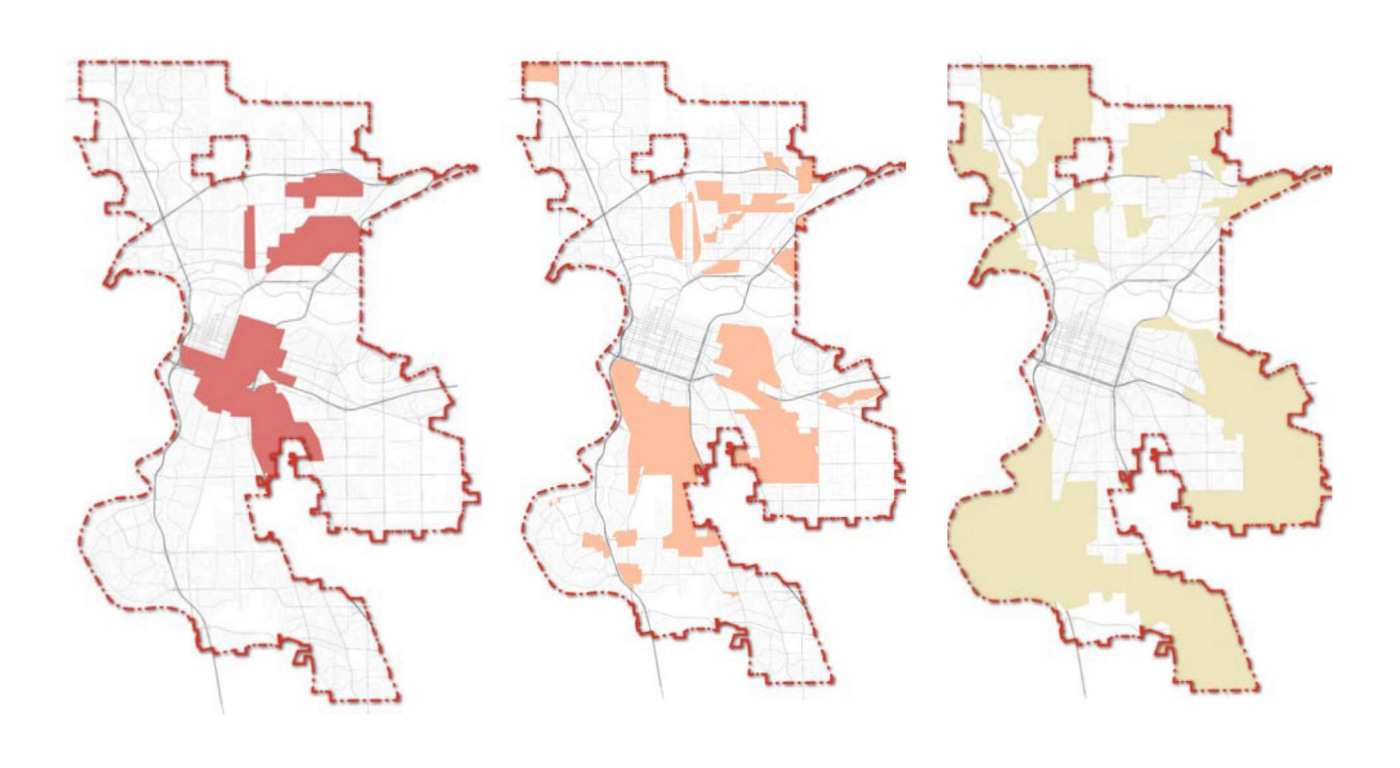
If they’re planning on creating Block Scale standards for, say, both “Compact + Connected” and “Transitional” zones, that’s great news! Together these two maps include all seven council districts, a great combination of higher-and-lower resource neighborhoods, and all of the transit- and amenity-rich areas where the city is most likely to actually see Missing Middle get built.
But if they’re just thinking of applying Block Scale in “Compact + Connected” neighborhoods? That might be a red flag. Or rather, a red line. Because, notice, that red map on the left looks a heck of a lot like the yellow and red areas of this map:
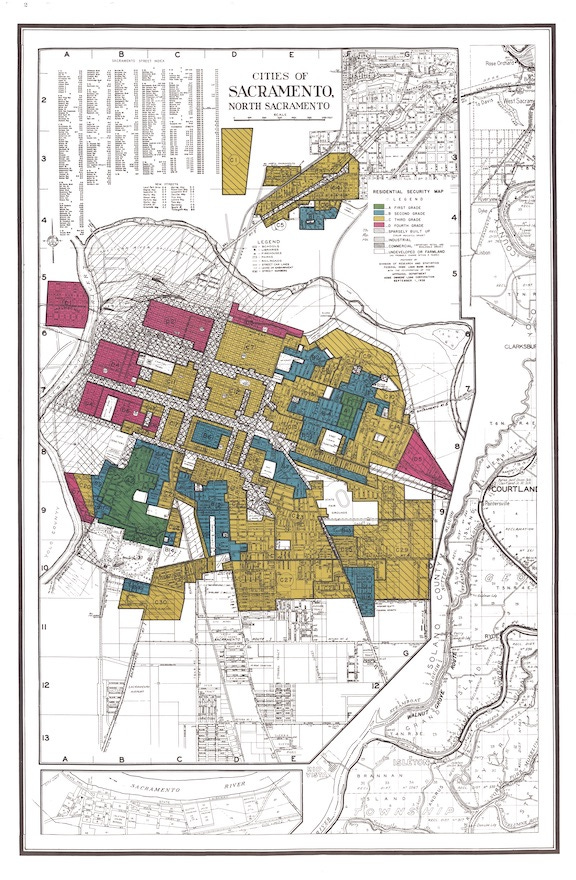
If the city ends up only applying this new more generous “Block Scale” Missing Middle standard to places like the Grid, Oak Park, Old North Sacramento, Northgate, and Del Paso Heights, it will accidentally perpetuate the deliberately racist planning decisions of the past. Oak Park and Old North Sacramento are only “Compact + Connected” because past generations of planners deliberately concentrated higher density affordable housing there while shielding places like Land Park and the Fab 40s from people seen as undesirable.
Maybe let’s not do that again?
But again, assuming they’re not making that mistake, then… this is great! Nice work!
Finally, a third bright spot. I love that the city is proposing incorporating the new height limits in SB79 directly into the city zoning code.
This doesn’t actually change what you’re allowed to build on these parcels. Wealthy developers with lots of lawyers know that state law preempts the local zoning maps and so the latter can be ignored.
This change simply means inexperienced developers without fancy lawyers now just have to check the local zoning map to know what they’re allowed to build. No need to know anything about state statute. That’s awesome and just how it should be.6
Again, simplify, simplify.
See you all at Planning Commission on Thursday.
One of those, a proposal for a FAR 1.5 tier, seems to be out of the blue and is not in our general plan. I’m not really sure what’s being proposed here — it may be an upzoning away from transit (which would be great news!) or it may be a downzoning near transit (which would be big time bad news).
“Minor,” “moderate,” and “transform,” the latter of which seems like a clear misnomer considering (one) how extremely-not-transformational Missing Middle production has been to date and (two) how incremental infill housing development always is. Plans on maps never transform cities in any timescale less than decades. It won’t here either.
At least among things the city can control, unlike tariffs and material costs and interest rates.
See the Sac Biz Journal on Sep 16, 2024: “House Sacramento to lobby Sac City Council over part of missing middle housing ordinance.”
Just to throw out a few other tweaks for how the city could hedge against “scary” buildings that would be less damaging than bulk control 2.0 as-proposed: 1. raise the “lowest eaves” height to ~28-30 ft, which would still allow the shortest possible code-compliant 3 story buildings but not at the full 35 ft; 2. waive bulk control 2.0 for lots adjacent to 2- or 3-story buildings; 3. only require bulk control 2.0 on lots smaller than a certain size; 4. … I dunno, require some extra trees or something around 3-story buildings?
Personally, I think it should be a point of pride in Sacramento that no one ever needs to use state law to pre-empt local rules. Every time state law allows more housing than local requirements, we should simply adjust our local requirements to match. Just like this.